
The Collection: An Archive of Judgement and Taste
Notes on a work in progress
From recto to verso
Taken together, this collection does not illustrate a linear history of printmaking, nor a succession of stylistic periods. It articulates instead distinct configurations in which time, space, and attention are organised through graphic form. Renaissance idealisation, Northern descriptive attention, Earthly Humanism, and the suspended temporality of classical landscape: each constitute a specific way in which the visible world becomes thinkable.
What the present collection makes legible is that these regimes are never purely formal. They are inseparable from the systems of judgement that have accompanied them across time: collectors’ marks, trajectories of ownership, and shifting criteria of taste and preservation.
The verso of the print is therefore not secondary to its recto; it is another surface of visibility, where historical perception has sedimented itself.
In this sense, the collection does not simply assemble images. It assembles forms of attention distributed across centuries, each selecting, preserving, neglecting, or requalifying what was visible. To look at these prints today is thus to encounter not only images of the world, but layered histories of looking: a continuous negotiation between what was seen, what was valued, and what has survived.
On authority of the past
What may the collectors’ marks found on the prints now in this collection still teach us?
The question does not address the perspective of the intrinsic qualities of the print and of its defects. From that standpoint, the worst possible fate for a collector would no doubt be for Lugt to identify his mark and judge that he had shown, throughout his life, little discernment in the choice of his sheets. I recall reading such a sentence about a collector whose name I failed to note: the verdict was brief, but as severe as it was final.
Rather than speculate on the judgment that some distant future may one day pass upon my own years of collecting, I prefer to reverse the question. I seek instead to assess the traces of quality left by those collectors who preceded me in the possession of the prints now gathered here.
What, then, do these marks from the past reveal about the collection in the present?
To answer this question, I’m systematically identifying the marks represented in the collection, relying, of course, on the standard reference catalogue compiled by Lugt. I then attempt to relate the quality of the sheets, the presence or absence of a watermark, and the esteem in which Lugt held the identified collectors.
A first observation emerges. In general, prints bearing collectors’ marks are often devoid of watermarks. The material sign that ordinarily reassures the collector as to the origin and authenticity of an impression is here replaced by the authority of a judgment already rendered by acknowledged connoisseurs.
The collectors’ mark thus substitutes, to some extent, for the full range of indicators that would today allow one to reconsider afresh the origin or date of an impression.
The collection also includes the earliest known mark of the dealer Naudet to date, on the verso of an impression of Jacques Callot’s The Temptation of Saint Anthony (iv/v).


As the Lugt catalog puts it: "Nous ne sommes pas en mesure d’expliquer la mention des dates relatives aux années 1760, comme celle de « Naudet 1760 » inscrite au verso de la gravure de Jacques Callot, la Tentation de saint Antoine, quatrième état sur cinq (coll. part.), ou bien de « Naudet 1763 » au verso d’une eau-forte de Francisque Millet, Le Voyageur (cat. Xavier Seydoux, Estampes anciennes et modernes, Paris 2014, no 16), ou celle de « Naudet 1769 » que Lugt a répertoriée sous le L.1938, figurant par exemple au verso d’une eau-forte de Rembrandt, Le bon Samaritain, 1633 (Fondation William Cuendet – Atelier Saint-Prex. Tome I. Catalogue des gravures de Dürer – Rembrandt, Lausanne 1979, no 149), car nous ne savons toujours pas à partir de quand Naudet a entrepris ses activités de marchand d’estampes."
Conversely, many other prints in the collection, though bearing watermarks and sometimes ranking among the rarest, carry no celebrated mark. Their origins were more discreet, yet their own signs spoke sufficiently for themselves. Even so, they have reached us incognito. They passed through the centuries without anyone pausing long enough to bestow upon them the dignity of a mark.
Balancing quality criteria
Taken together, these signs suggest not a cabinet of first-rank perfection, but a collection shaped by margins, survivals, and exceptions. Certainly, some sheets are of extreme rarity; others of extraordinary quality. Yet almost always some reservation attaches to them: a defect that required restoration, a concession on condition that had to be accepted, an insufficiency that had to be overlooked.
Every collection is a compromise. I tend to privilege artistic and impression quality over material perfection. Other collectors would inevitably make different choices.
To attain recognisable perfection in taste would require other means, other budgets. Yet even that would not suffice. The collector lives in expectation, perpetually alert, scrutinising every opportunity for the decisive chance: the one that appears only once and may change everything.
And indeed, many prints rediscovered today were overlooked by the chain of collectors who came before.
Thus an impression of a major plate by Claude Lorrain, printed during the artist’s lifetime, was sold to me as a McCreery impression of the early nineteenth century. A chiaroscuro woodcut dismissed by bidders because of tears required only to be looked at anew. So too Parmigianino’s Entombment, for which a light restoration restored the missing upper margin, despite the sheet’s exceptional importance in the history of the Renaissance, on the eve of the world shaped by Raphael’s death and the Sack of Rome.
Each time, the old drama of discovering a treasure is played again: a print described as a copy, deemed mediocre, or left in obscurity suddenly recovers, once rescued from anonymity, its place and its dignity.
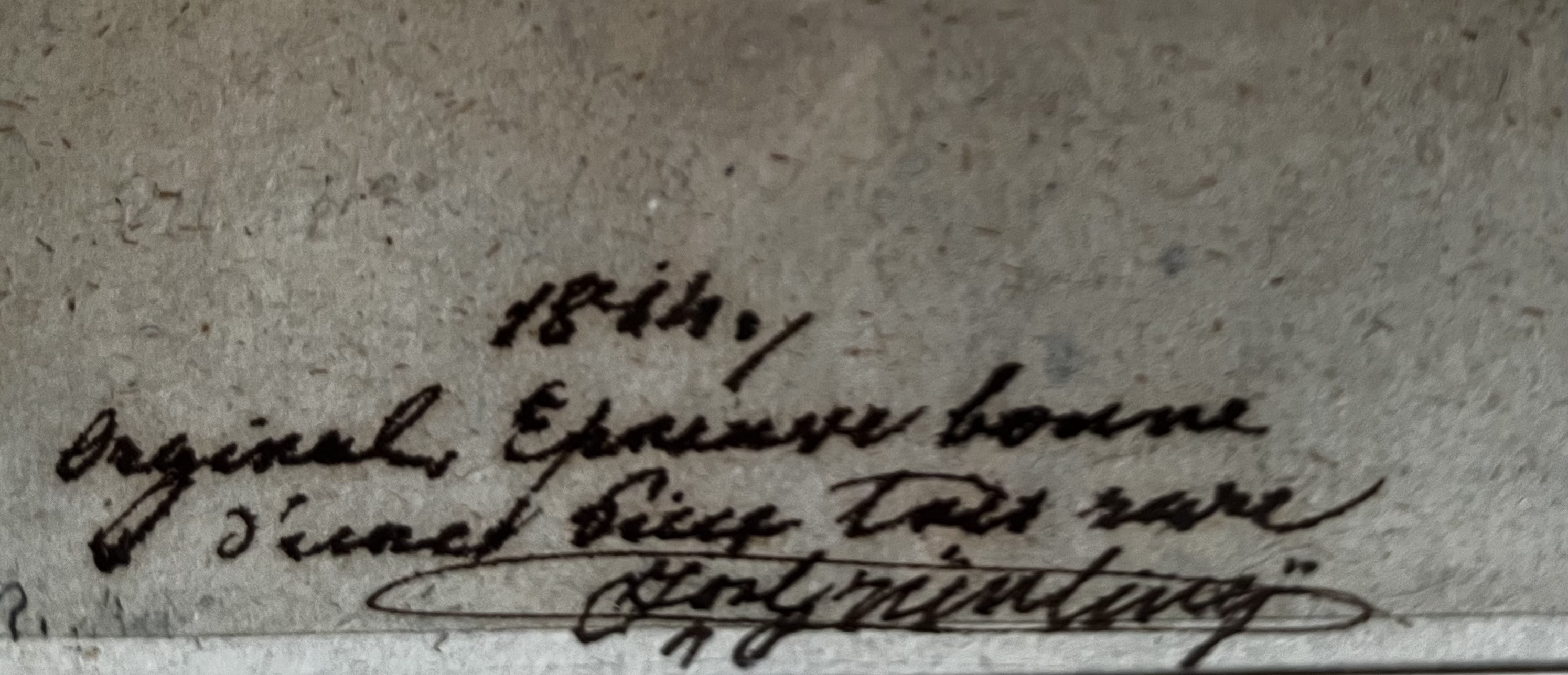
Handwritten note and signature of the Viennese dealer Joseph Grünling, dated 1814 (he was 19 by then), before the later simplification of his signature and the subsequent introduction of wooden and metal stamps: verso of Lucas van Leyden The Milk Maid, 1510 (state b). The note reads: "1814: Original, fine impression of a very rare print."
When I question the meaning of accumulating these long-neglected sheets, it is to this act of restitution that I return to steady my doubt.
To restore place and dignity to what had been forgotten: perhaps that is achievement enough.
The methodology
| Auteur | Titre | Date | Marque de collection | Condition générale | Filigrane | État | Commentaire |
|---|---|---|---|---|---|---|---|
| G.A. da Brescia | Les Sénateurs | c. 1500 | L.617 (Antonio Cesare Poggi, Londres, fin 18e – c. 1836) | Correcte, déchirures, amincissements | – | Excessivement rare | |
| H. Hopfer | Bataille d’hommes nus | avant 1563 | L.567 (collection des ducs d’Arenberg) | Superbe, pleines marges | – | ||
| M. Raimondi | Il Morbetto | 1515 | L. 5253 (Philippe Hanus, 1951, France) | Très endommagé, nombreuses restaurations successives | – | Rare | |
| M. Dente | Nymphe portée par un triton | 1512-1513 | L. 4431 (collection française de la seconde moitié du XVIe siècle) | Superbe | – | publiée par Salamanca et Lafreri entre 1553 et 1563 | |
| F. Mazzola | La mise au tombeau | 1527 | L.739 (collection Defer-Dumesnil, Paris, 19e siècle: Pierre Defer 1798-1870; Henri Dumesnil 1823-1898) | Superbe, mais quelques restaurations, manque restauré de 1,5 cm sur la partie supérieure | – | ii/ii | Très rare |
| Rembrandt | Le Christ disputant les docteurs de la loi | 1630 | L.1257e et L.1257d (cabinet des estampes du musée du Land de Hesse, Darmstadt) | Superbe | – | iv-v/viii | Rare |
| N. Moeyaert | Le songe de Jacob | 1630 | L. 1966 (timbre sec du Prince Nicolas Esterhàzy, 1765-1833, Vienne) | Très belle | – | i/ii | Très rare |
| B. Biscaïno | Moïse sauvé des eaux | c. 1650 | L. 2650 (William Sharp, Manchester, milieu du XIXe siècle) | Très belle | – | ii/viii | |
| G. Dughet | Paysage en largeur no. 2 | c. 1640 | Lugt 1937 (« à Paris chez Naudet md d’estampes au Louvre 1806 ») | Très belle | – | ii/ii | Rare |
| P. de Laer | Femme assise | c. 1630 | L. 2064 (L. Puttrich?, 1783-1856). | Très belle impression mais manques et restaurations | – | unique | Rare |
| P. de Laer | Paysage avec deux arbres | c. 1630 | L.2071 (P. Burty, Paris, 1830-1890) | Très belle, petites marges | – | i/ii | Rare |
| B. Breenbergh | La maison délabrée | c. 1640 | L.3183 (J. Wetterauer, Stuttgart) | Très belle impression, barbes, mais quelques plis | – | unique | Rare |
| B. Breenbergh | La Villa de l’Empereur | c. 1640 | L.700a (Musée Boijmans van Benningen de Rotterdam); L.356b (Musée Boijmans van Benningen, don de A.J. Domela Nieuwenhuis en 1923) | Très belle impression, mais plis et amincissements, restaurations | – | i/ii | Rare |
| J. van Noordt | Paysage avec des animaux et une laitière | 1644 | L. 2200 (cachet sec de Robert-Dumesnil, 1778-1864, auteur du Peintre-graveur français). | Très belle, uniformément insolée | Folie | i/ii | Rare |
| T. Wijck | L’homme ajustant sa chaussure | c. 1650 | Collection G. Denzel (Munich), pas dans Lugt | Correcte | – | ||
| T. Wijck | La fileuse et le forgeron | c. 1650 | L. 787 (Dr. A. Sträter, 1810-1897); L. 847a, L. 919 ter (E. Fabricius, † c. 1920); L. 1403b (J.H. Juriaanse, 1866-1940). | Excellente | contremarque | ||
| T. Wijck | La tour ronde | c. 1650 | L. 2675 (C. von Zephraovitch, major d’armée, Vienne, seconde moitié du XIXe siècle); L. 1626a (J. Kuderna, marchand d’art à Vienne, début du XXe siècle). | Très belle | iii/iv | ||
| T. Wijck | Le puits | c. 1650 | L. 3974 (K. Herweg, 1914-2002). | Taches et amincissements | – | iii/iv | |
| T. Wijck | Une fileuse et un pêcheur | c. 1650 | L.4731 (Pieter van Doorne, Amsterdam 1896-1971) | Superbe | – | ||
| J. Both | Les deux vaches | c. 1640 | L. 88 (A. Camesina, 1806-1881, graveur à Vienne) et L. 1105b (F. Goldstein, né en 1888, Vienne). | Superbe, restauration du coin inférieur | Fleur de Lys couronnée dans un écusson | iii/vi | |
| N. Berchem | La vache qui pisse | c. 1650 | L1293 (Hieronymus von Bayern, Munich, 1792-1876); L.2926 (Rudolf P. Goldschmidt, Berlin, 1840-1914) | Superbe | ii/v |
to be continued…
 Homepage