
Partie centrale: Neptune apaisant la tempête qu’Éole avait excitée contre la flotte d’Énée
Cliquez sur l’image pour l’agrandir
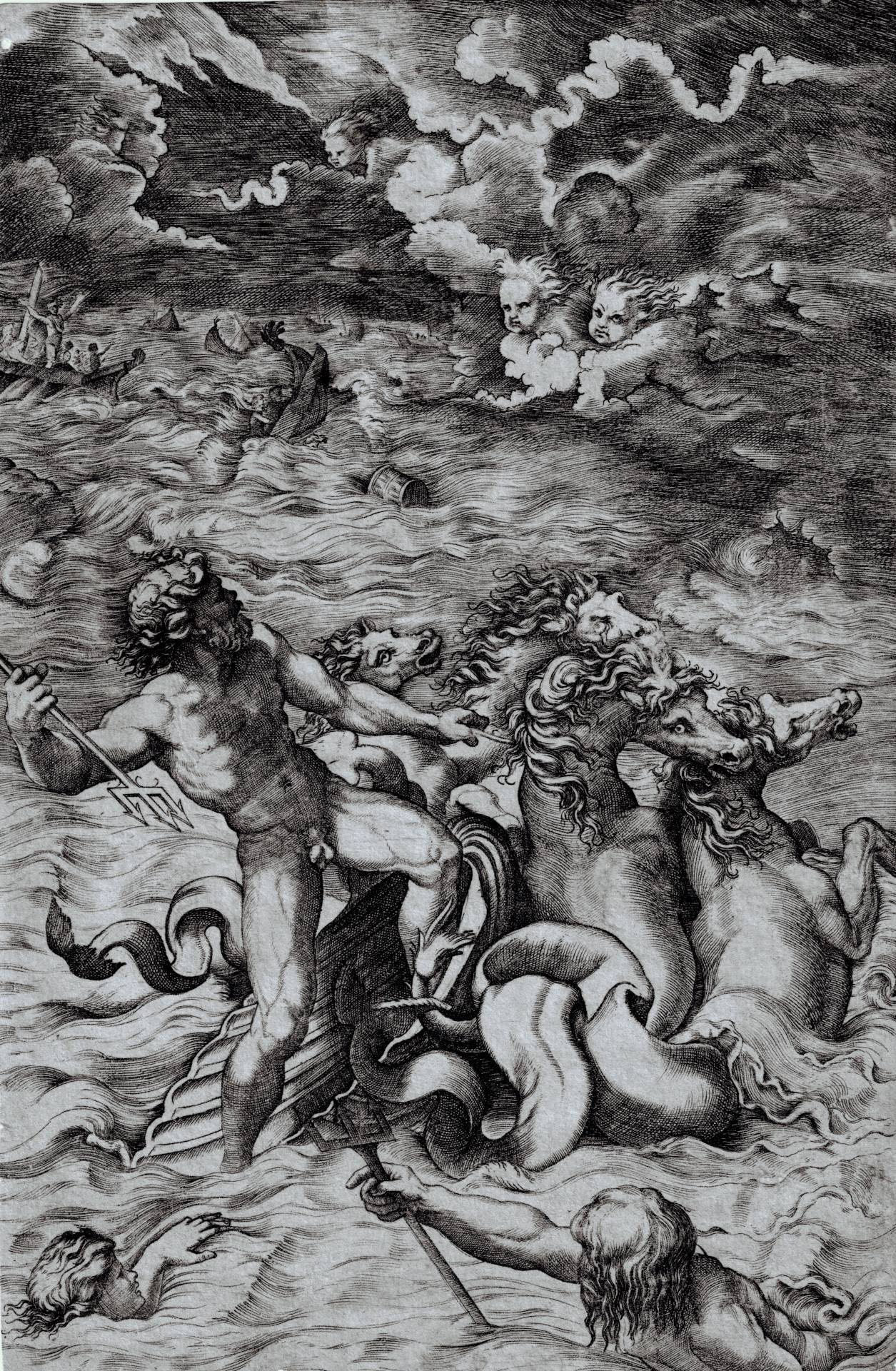
Artiste: Marcantonio Raimondi (Sant’Andrea c. 1480 – c. 1534 Bologne), d’après Raphaël
Date: 1515-1516
Technique: burin
Dimensions: cm
Catalogue raisonné: Delaborde 102, i/ii; Bartsch XIV.264.352
Filigrane: fragment
Superbe impression de la partie centrale du Quos Ego (scène où Neptune Calme la Tempête), d’après un dessin préparatoire de Raphaël pour être gravé par Marcantonio. Il s’agit ici du (rare) premier état, avant que Villamena ne reprenne la plaque et ajoute de nombreux travaux, notamment des points entre les lignes tracées par Marcantonio, des modifications de l’expression des personnifications du vent ou de la direction du regard du deuxième cheval à partir de la droite (le premier état le montre nous regarder quand le second état trouble la direction de ce regard).
An excellent study of the sources for Marcantonio’s Quos Ego after Raphael has been made by Lawrence Nees, who shows that the compositional format of the engraving was inspired by a type of small Roman relief of the first century A.D., known as a tabula iliaca. (…) Nees also investigates the immediate source for the engraving, which he believes was designed by Raphael in ca. 1515 specifically for Marcantonio to engrave. That the source for the engraving was Raphael and not Peruzzi, as has been suggested by others, is confirmed by the similarity of the Neptune scene to Raphael’s Vision of Ezekiel (Florence, Pitti Palace) and also by the existence of a heavily pricked and damaged drawing at Chatsworth of the scene of Ilioneus and the Trojans before Dido. Nees considers the drawing to be a preliminary sketch by Raphael for the engraving; it is at least a drawing from the Raphael workshop. The main scene in the center of Neptune Calming the Tempest is also thought to be based upon a lost Raphael project for a composition reflected in a copy of a lost drawing, now in Bergamo (Accademia Carrara).
The Quos Ego must also be considered as a major work in the oeuvre of Marcantonio, for it is a composition of major proportions and complexity. On the basis of style, it seems to date from about 1515-1516, the period in which the engraver was simultaneously developing his systematic modeling technique and his manner of creating atmospheric and chiaroscuro effects. Although no other print by Marcantonio is really comparable to the Quos Ego, there are similarities of a general kind to contemporary works such as The Morbetto and the St. Cecilia. In all these prints, the buring work is dense and fine, and in rich impressions this produces an almost granular texture in areas of darkness. The chiaroscuro effects are particularly flamboyant in the central scene of the Quos Ego, where the nude figure of Neptune is dramatically highlighted in response to the flashes of lightning in the tempest. Marcantonio’s handling of the ruffled waves and blowing coulds recalls Dürer’s waves in the engraving of the Sea Monster or the dark skies in some of the Apocalypse woodcuts.
Innis H. Shoemaker, The engravings of Marcantonio Raimondi, Lawrence (Kansas), Spencer Museum of Art, 1981, p. 120.
 Homepage