
Cliquez sur l’image pour l’agrandir
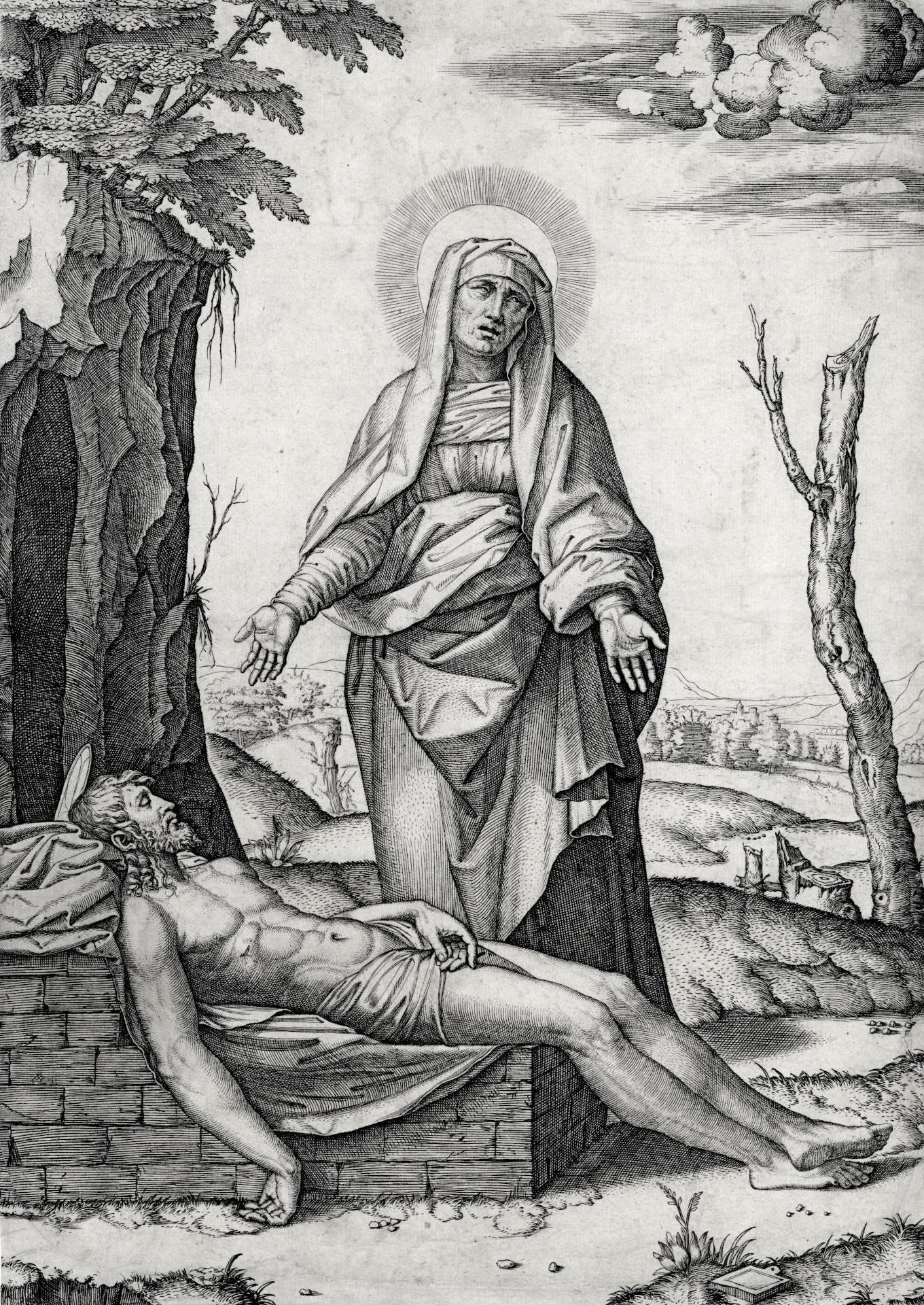
Artiste: Marcantonio Raimondi (Sant’Andrea c. 1480 – c. 1534 Bologne)
Date: 1515-1517
Technique: burin
Dimensions: 29,9 x 21,3 cm
Catalogue raisonné: Delaborde 20
Filigrane: oiseau (?) dans un cercle d’environ 3,8 cm de diamètre
Excellente impression, particulièrement contrastée et très fraiche. De nombreux accidents sur les bords, coupée à l’intérieur de la marque du cuivre, manques (angles hauts gauche et droite, ainsi qu’une bande de 0,5 cm dans la partie inférieure et ses deux angles). Il s’agit de la seconde version du sujet gravée par Marcantonio. La première version (« La pietà au bras nu », 1512) a fait l’objet de discussion quant à son attribution certaine à Marcantonio et renvoyait à un dessin de Raphael ou de son école, aujourd’hui conservé au Louvre.
In his second version of The Pietà, Marcantonio created a more evocative and explicit image of suffering, by substituting a haggard woman, stricken with grief, for the youthful Madonna of the earlier version, and by adding the wound on a now less generalized, more human representation of the dead Christ. Marcantonio further intensified the pathos of the composition by adding the gaunt tree to the right, which not only underscores the mood of The Pietà, but also serves to restrict and frame the composition in a balanced and more severely planar format. The background landscape, stripped of its delicate, atmospheric qualities and its genre details, functions as an expressive void against which the grieving Madonna stands in stark relief. From the first version, only the rocky tomb, derived from Lucas van Leyden’s Madonna of the Desert (B.VII,123) remains unchanged. The transformation of The Pietà into a more monumental, austere, and rigidilly organized composition is consistent with Marcantonio’s development during his mature Roman period. (…) In this mature work, both style and technique are harmoniously united in creating one of the most compelling images of Marcantonio’s oeuvre. (The Pietà was one of Marcantonio’s most popular compositions. Copies or versions of it were made by Giulio Bonasone and Jerome Wierix. An altarpiece by l’Ortolano in the Museo Nazionale, Modena is also based on the engraving.
Caroly H. Wood in Innis H. Shoemaker (dir.), The Engravings of Marcantonio Raimondi, Lawrence et Chapel Hill, Spencer Museum of Art (University of Kansas) / Ackland Art Museum (University of North Carolina), 1984 (1981), p. 131-132.
Raphael’s scheme responds to the demonstrative appeal of Michelangelo’s Pietà of a dozen years earlier, but the only direct connection is the flexing of Christ’s left hand. A year or two later, in the Viterbo Pietà, Sebastiano del Piombo (c. 1485-1547), working to Michelangelo’s design, re-interpreted Raphael’s design by laying Christ’s body on the ground and seating the Virgin directly behind him, her hands clasped in prayer.
Paul Joannides in Edward H. Wouk (dir.), Marcantonio Raimondi, Raphael and the Image Multiplied, Manchester, Manchester University Press, 2016, p. 216.
 Homepage